

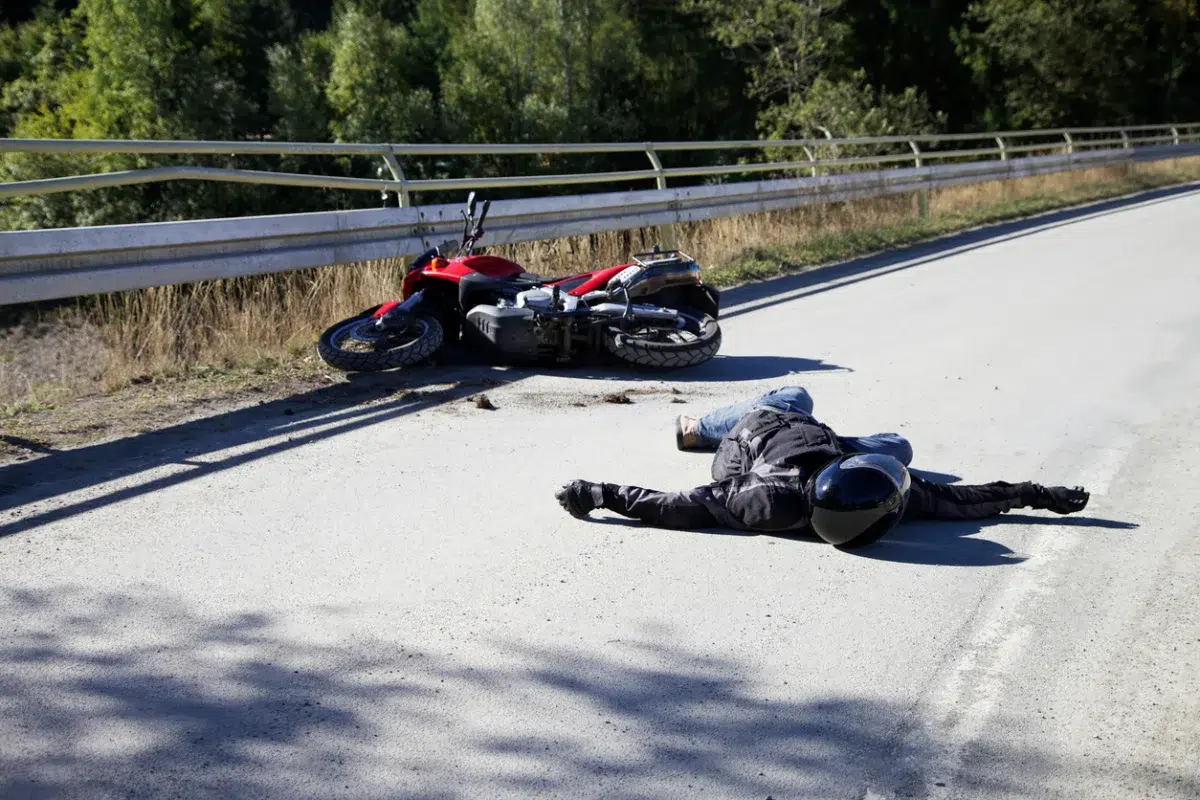

A no-contact motorcycle accident, often referred to as a “phantom vehicle” crash, occurs when a motorcyclist is forced to swerve, crash, or lay down their bike due to another driver’s actions, without any physical contact between the two vehicles. Despite the absence of a direct collision, these accidents can cause catastrophic injuries or even fatalities. Understanding liability in these cases is essential, especially in California, where motorcycle accidents are all too common and legal nuances can significantly affect claims.
If you were injured in a motorcycle crash and need legal guidance, consult a motorcycle accident attorney or explore your options through our personal injury legal services.
No-contact accidents tend to be more complex to investigate and prove. The lack of physical evidence and the potential for the at-fault driver to flee the accident scene only add to the difficulty. However, with the right evidence and legal representation, injured motorcyclists can still hold negligent drivers accountable and recover the compensation they deserve.
Common Causes of No-Contact Motorcycle Accidents
While each no-contact crash is unique, certain driver behaviors frequently contribute to these incidents. Understanding these common causes not only helps clarify liability but also empowers motorcyclists to stay alert and protect themselves on the road.
- Sudden lane changes: Motorists who change lanes abruptly, especially without signaling or checking blind spots, often cause panic reactions in nearby motorcyclists. When a car veers into a rider’s lane unexpectedly, the motorcyclist may be forced to swerve, brake abruptly, or even crash into a barrier or another vehicle. Lane splitting, legal in California, further complicates this risk because drivers may not expect a motorcycle passing between lanes.
- Tailgating and aggressive driving: Drivers who follow motorcycles too closely or engage in road rage behaviors (such as cutting off riders or brake-checking) create high-pressure situations where motorcyclists must react quickly. These aggressive maneuvers can lead to overcorrection, skidding, or losing control entirely, without the aggressive driver ever making physical contact, leading to severe motorcyclist crashes.
- Failure to yield: A driver who runs a stop sign, turns in front of an oncoming motorcycle, or fails to yield during a merge may trigger a no-contact crash. For example, a motorcyclist may have to swerve into another lane or off the road entirely to avoid T-boning a car that violates the right-of-way.
- Distracted driving: When drivers are preoccupied with texting, eating, adjusting the radio, or using navigation systems, they become unaware of their surroundings. A distracted driver might drift into another lane, stop suddenly, or fail to see a motorcyclist altogether, prompting a crash avoidance maneuver that results in a wreck.
- Speeding: Speeding drivers often lack the time or space to make safe decisions. If a driver speeds up behind a motorcyclist or overtakes them recklessly, the rider may need to take evasive action. Speed also increases stopping distance, making collisions more likely, even if avoided at the last second.
- Poor signaling and erratic movement: Drivers who fail to use turn signals, change lanes erratically, or weave in and out of traffic present unpredictable dangers. Motorcyclists must constantly anticipate others’ actions, but erratic driving leaves little time to respond safely.
- Impaired driving: Drivers under the influence of alcohol or drugs exhibit delayed reactions and poor judgment. Even without crashing into a motorcyclist directly, their erratic driving patterns—such as veering, tailgating, or drifting—can cause motorcyclists to take emergency action that ends in a solo crash.
In many no-contact motorcycle accidents, the at-fault driver may continue without realizing they caused a crash, or worse, knowingly flee the scene to avoid liability, as they might not be a reasonable person. These so-called “at-fault phantom drivers” make it difficult to identify a responsible party, but that doesn’t mean they can’t be held accountable. With the right evidence and legal strategy, liability can still be established even without direct contact.
Seeking Financial Compensation for No-Contact Motorcycle Accidents
Victims of no-contact motorcycle crashes in California may be entitled to substantial compensation for various damages. Understanding the full range of compensable losses and the avenues available for recovery is essential for building a strong claim.
- Medical Expenses: These often represent the most significant financial burden after a motorcycle crash. Compensation can cover emergency room visits, diagnostic imaging (X-rays, MRIs), surgeries, hospital stays, physical therapy, chiropractic care, long-term rehabilitation, medication, and assistive devices such as wheelchairs or prosthetics. Future medical costs for ongoing treatment or therapy can also be included.
- Lost Wages and Reduced Earning Capacity: Many motorcyclists involved in no-contact accidents are forced to miss work due to their injuries. Compensation can account for income lost during recovery, as well as diminished earning capacity if the rider is unable to return to their prior job or career field. For instance, a construction worker with a permanent leg injury may not be able to perform the same duties again, resulting in long-term financial consequences.
- Property Damage: Victims are entitled to compensation for motorcycle repairs or, if the bike is totaled, the fair market value of the motorcycle. This category may also include damaged riding gear, helmets, mobile phones, and any other personal items damaged in the crash.
- Pain and Suffering: These non-economic damages account for the physical pain, emotional distress, anxiety, trauma, and loss of enjoyment of life caused by the accident. Psychological harm—such as PTSD, depression, or fear of riding again—is compensable and can significantly increase the value of a claim.
Avenues for Compensation
When the at-fault driver is known and identified, the most straightforward route is to file a claim against their liability insurance. However, no-contact crashes often involve phantom drivers who flee the scene, leaving victims with alternative options:
- Uninsured/Underinsured Motorist (UM/UIM) Coverage: California insurance policies typically include this as optional coverage, but it is highly recommended for motorcyclists. UM/UIM applies in cases where the at-fault driver is unidentified or lacks sufficient insurance. It can be the most valuable source of recovery in phantom vehicle cases.
- Personal Injury Lawsuits: If the at-fault driver is identified and their insurance is insufficient—or refuses to pay—injured riders may file a civil lawsuit to pursue additional compensation. These cases can include claims for punitive damages if the driver acted with extreme recklessness or fled the scene.
- Third-Party Claims: Liability isn’t always limited to another driver. Poorly maintained roads, faulty traffic signals, or debris in the roadway may involve government agencies or contractors. Claims against municipalities or Caltrans require compliance with strict notice deadlines, but they can provide compensation if government negligence contributed to the accident.
Determining Liability and the At-Fault Driver in No-Contact Crashes
In California, liability in a no-contact motorcycle accident still rests on the concept of negligence. If another driver’s actions directly caused the motorcycle rider to crash—even without a physical collision—that driver can be held responsible.
For instance, a driver who abruptly changes lanes without signaling may cause a motorcyclist to veer off the road. Even if the vehicles never touch, the driver’s behavior sets off a chain of events leading to the crash. Such drivers are legally considered at-fault.
However, establishing liability without contact involves proving that the other party’s actions caused the accident. This often requires:
- Witness statements
- Dashcam or traffic camera footage
- Physical evidence from the crash site
- Expert accident reconstruction
If the phantom driver leaves the scene (making it a phantom vehicle case), things get even more complex. Yet, that doesn’t absolve them of responsibility. With the help of a qualified motorcycle lawyer in San Francisco, California, victims can still prove fault, pursue a legal claim, and seek compensation.
Proving Liability in a No-Contact Motorcycle Accident
Unlike contact accidents, determining fault in a no-contact motorcycle accident in California is more nuanced. Here’s how victims and their legal teams can approach the challenge:
- Circumstantial Evidence: Even without a collision, skid marks, debris patterns, and damage to surrounding property can tell the story.
- Eyewitness Testimony: Third-party accounts may validate your claim that the other motorists caused the crash.
- Surveillance Footage: Cameras from nearby intersections, stores, or even residential buildings can provide crucial footage.
- Motorcycle Damage: The location and nature of the bike’s damage may support the rider’s account.
Importantly, California follows a comparative negligence rule, meaning that if the motorcyclist shares some fault, their compensation can be reduced proportionally. This further underscores the importance of building a compelling, evidence-backed claim.
The Role of Insurance Companies in No-Contact Claims
Once you’ve been in a no-contact accident, you will inevitably have to deal with insurance companies—both yours and potentially the at-fault driver’s, if they are found. This process is often where injured riders face their biggest hurdles.
Insurance adjusters are trained to minimize payouts. In a phantom collision legal claim in California, they will often seize on the lack of physical evidence of a collision to deny the claim or argue that you, the rider, were solely at fault. They might suggest you simply lost control of your motorcycle. This is why having experienced legal representation is so vital.
Your insurance coverage is your first line of defense, particularly if the driver of the other vehicle is never identified. This is where Uninsured/Underinsured Motorist (UM/UIM) coverage becomes invaluable.
- Uninsured Motorist (UM) Coverage: This part of your policy can cover your damages if you are injured by a hit-and-run driver or a driver who has no insurance. In California, a phantom vehicle accident is often treated as a hit-and-run, allowing you to file a claim under your UM coverage.
- Underinsured Motorist (UIM) Coverage: This applies if the at-fault driver is identified but has insurance limits that are too low to cover the full extent of your damages.
Filing an insurance claim after a bike accident requires meticulous documentation and a clear presentation of the facts. A law firm can help you navigate this complex process, handle all communications with the insurance companies, and negotiate for a fair settlement that covers your medical bills, property damage, and other losses. A free consultation with an attorney can provide clarity on your options and the strength of your case.
What to Do After a No-Contact Motorcycle Accident
The actions you take in the minutes, hours, and days following a no-contact motorcycle swerved off-road incident can significantly impact your health and the viability of your legal claim.
- Prioritize Your Safety and Health: First, get to a safe location away from traffic. Then, seek medical attention immediately. Adrenaline can mask serious injuries. Delaying treatment can not only harm your health but can also be used by insurance companies to argue your injuries weren’t caused by the accident.
- Contact the Police: Always report the accident to the police. Insist that they come to the scene and file an official report. Provide them with as much detail as you can remember about the phantom vehicle—the make, model, color, license plate number (even a partial one), and a description of the driver. A police report creates a formal record of the incident.
- Document Everything at the Scene: If you are physically able, use your phone to take pictures and videos. Capture the entire scene, including your motorcycle’s position, skid marks on the road, any debris, road conditions, traffic signals, and your injuries.
- Gather Witness Information: This is arguably the most important step in a no-contact case. Look for anyone who saw what happened. This could be other drivers, other motorcyclists’ accounts, pedestrians, or workers in nearby buildings. Get their names, phone numbers, and ask them what they saw. A third-party witness who can corroborate your account that another vehicle caused you to crash is incredibly powerful evidence.
- Do Not Admit Fault: Never apologize or say anything that could be interpreted as an admission of fault to anyone at the scene or to an insurance adjuster.
- Notify Your Insurance Company: Report the accident to your insurer as soon as possible, but stick to the facts. State that you were involved in an incident caused by another vehicle that made no contact and left the scene.
- Seek Legal Advice: Before giving a recorded statement to any insurance company, contact an experienced motorcycle accident lawyer. Legal advice for motorcycle accidents is crucial at this stage. A law firm can protect your rights and guide you through the next steps.
Why Legal Representation Matters
Recovering compensation in a no-contact motorcycle accident is rarely straightforward. Insurance companies may dispute liability, deny that a phantom driver existed, or minimize the extent of injuries. Experienced motorcycle accident attorneys know how to:
- Locate and interview witnesses
- Secure and analyze surveillance or dashcam footage
- Work with accident reconstruction experts
- Handle complex insurance negotiations
- File appropriate legal paperwork on time
By building a detailed and well-supported case, attorneys increase the likelihood of securing a fair settlement or winning in court. Victims should never attempt to navigate these challenges alone, especially in cases involving phantom vehicles.
Conclusion: Legal Guidance for No-Contact Motorcycle Accidents
No-contact motorcycle accidents can leave victims physically injured, emotionally distressed, and financially burdened. Although these incidents are complex, California law still allows for injured motorcyclists to hold negligent parties accountable, even if the other driver never touched them.
From understanding phantom vehicle liability to negotiating with insurers and securing rightful compensation, an experienced attorney is your best ally. If you’ve been injured in a no-contact collision in the Bay Area, contact Delfino Green & Green to explore your legal options and get trusted advice alongside dedicated representation.
Start your recovery journey by reaching out for a free consultation with our motorcycle accident legal team. We’re here to help you understand your rights and take the next steps toward justice.
Disclaimer: This content is for informational purposes only and does not constitute legal advice. For personalized legal assistance, please contact Delfino Green & Green directly.